 Barvinok
Guide
How to make a bouquet last longer
We do not promise how long a bouquet will hold — that depends on the flowers and on what goes on in your home. But half of that time is in your hands, and everything that really works is here.
The basics
Five things
that work
The first two are done once, as the flowers go into the vase, and they give you the most. The rest is a matter of water and of where the vase stands.
Trim the stems
With a sharp knife, at an angle, two or three centimetres — and straight into water. At an angle, because the stem then does not sit flat on the bottom and drinks with its whole surface. A knife, not scissors: scissors crush the channels the water travels through.
Strip the lower leaves
Anything that would end up under water has to come off. A leaf in water rots within two days, the water clouds over, and bacteria block the stem from the inside — that is the most common reason a bouquet wilts sooner than it should.
Cool water, changed
Every day or every other day, and rinse the vase while you are at it. Topping it up is not enough: the problem is not the level of the water but what is growing in it.
A spot away from heat
Not on the radiator, not in full sun, not in a draught and not on top of the television. Cooler means longer — if you can, move the bouquet to a colder room for the night.
Away from fruit
A bowl of apples or bananas next to the vase costs the bouquet several days: ripening fruit gives off ethylene, and to a flower that is the signal that it is time to go over.
Special cases
Not every flower
wants the same thing
A few kinds have habits of their own. They are worth knowing, because these are usually the ones that look "spoiled" while behaving perfectly normally.
Tulips
They keep growing a few more centimetres in the vase and bend towards the light — that is not a fault, that is a tulip. They want shallow water and a cool room. If they are to stand straight, pack them in tightly and turn the vase once a day.
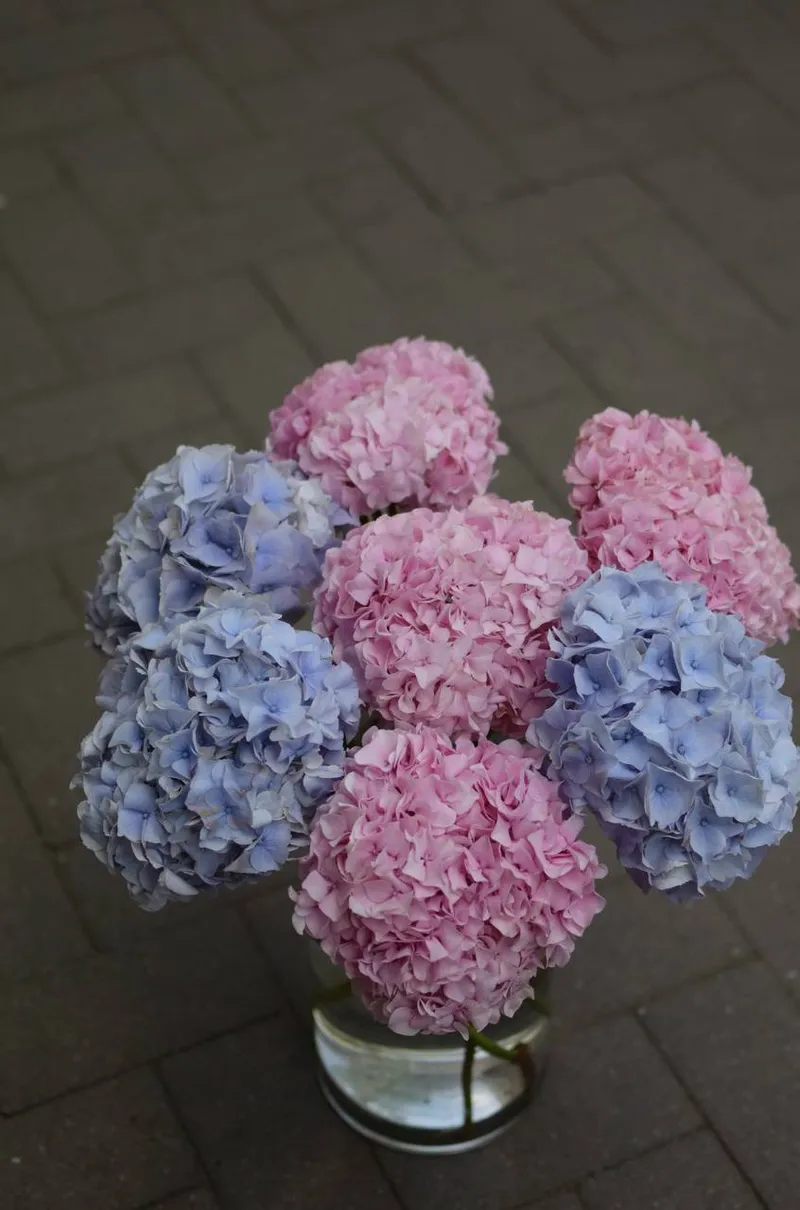
Hydrangeas
They drink through the flower head as well as the stem. When a head starts to droop, dip it in cold water for twenty to thirty minutes — it usually comes back. They cannot bear dry, warm air.
Peonies
They arrive closed, and that is a good thing: they open in the warmth over two or three days. Want them sooner — stand them somewhere warmer; want them later, for a particular day — keep them cool.
Roses
The outer petals are often darker and thicker — those are guard petals, not damage; you can take them off. If a rose hangs its head, cut the stem again and stand it for an hour in deep, cool water.
Chrysanthemums and carnations
The toughest flowers in the vase — they can stand two weeks and more. Worth remembering when a bouquet has to wait for someone's return or travel a distance.
A bouquet in a hat box or a basket
Inside there is floral foam soaked with water. You do not change that water — you add a little every other day, so that the foam stays damp without standing in a puddle.
Questions
Something happening
to your bouquet?
Call or write and describe what you see — a photo helps most. We will tell you whether the flower is behaving normally or whether something can still be done.
- +48 733 061 838Phone and WhatsApp
- Shop — Mazowiecka 28B, KrakówKrowodrza district